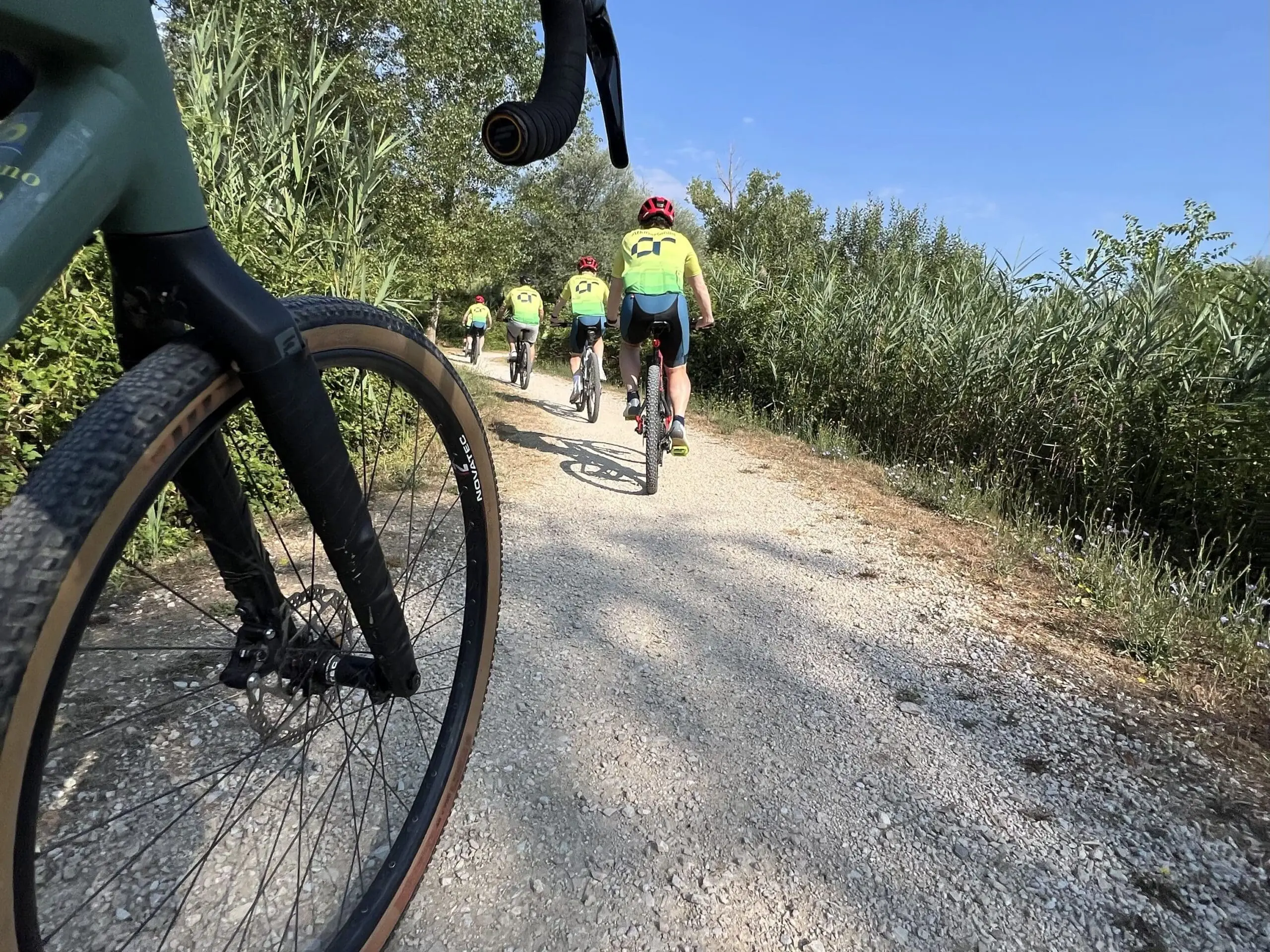
Gravel cycling in Umbria begins where the asphalt ends. The road turns white and dusty, the sound beneath your tyres changes, and a country track climbs through olive groves towards Monte Subasio without a car in sight for kilometres.
That is what makes this region special: ridgelines, olive groves and white roads forgotten by traffic, seemingly made for anyone with knobbly tyres and the desire to leave the beaten track behind.
And yet, if you search for detailed guides on where to ride, you find surprisingly little. It is a paradox that becomes an opportunity. The terrain is here, the routes are here, but nobody has really told their story properly yet.
So let’s do it, with the numbers in front of us.
Why Umbria is made for gravel cycling
Umbria is a region of ridges and narrow valleys, and you can feel that beneath your wheels.
According to Regione Umbria, the regional cycle network includes flat routes along rivers and former railway lines, together with routes on low-traffic roads and mountain bike trails.
For gravel riders, the message is clear.
Alongside paved cycle paths lies a dense web of minor roads, dirt tracks and semi-abandoned routes connecting villages, farms and mountain passes.
These are Umbria’s traditional white roads, rural tracks that local people have used for generations, without anything artificial or purpose-built about them.
In terms of cycling trends, gravel is now firmly established.
According to ANCMA data for 2025, the road/gravel category accounts for around 16% of non-electric bicycles sold in Italy, within a market that reached 1.3 million units during the year.
It is therefore a mature segment nationally.
The difference lies elsewhere: in Umbria, this audience exists, but there is still no real guide speaking directly to it.
Visitors arriving with a gravel bike often have to piece together their trip using apps, stage by stage.
Our aim is to bring some order to the picture, starting with the areas where both the terrain and the available data are clearest.
Monte Subasio: the heart of gravel cycling in Umbria
If we had to recommend just one place to start, it would be Monte Subasio.
The mountain overlooking Assisi is part of a 7,186-hectare regional park extending into the municipalities of Nocera Umbra, Spello and Valtopina. Its summit reaches 1,290 metres, according to the official Parks.it profile.
The detail that really makes the difference is the road surface: all the roads leading to the summit are unpaved.
There is no fully asphalted way to conquer Monte Subasio by bike.
You either climb it on white roads or you do not climb it at all.
For gravel riders, that is an invitation that is difficult to resist.
The area is so well suited to gravel riding that Komoot has created a dedicated guide listing more than 140 gravel routes around the park.
We have selected a few of them, with the key figures, so you can immediately understand what kind of day to expect:
| Route | Distance | Elevation gain | Difficulty |
|---|---|---|---|
| Assisi, Collepino, Monte Subasio | 44,9 km | +1.210 m | Hard |
| Assisi, Foligno, Montefalco, Bevagna | 78,6 km | +700 m | Hard |
| Assisi, Bettona, Cannara | 46,3 km | +290 m | Moderate |
| Assisi, Gualdo Tadino | 86,7 km | +1.540 m | Hard |
(Data from Komoot’s gravel guide to Monte Subasio Regional Park.)
Take the first route, the Assisi–Collepino–Monte Subasio loop: 44.9 kilometres with 1,210 metres of elevation gain, according to the detailed data on Komoot.
However, there is an important point to clarify — exactly the kind of detail an experienced cycle traveller cares about more than any catchy description.
The route is labelled “gravel”, but the actual surface composition is only around 21% unpaved. The rest consists of secondary asphalt roads and paved sections.
It is therefore a mixed-surface loop, with a substantial gravel climb towards Collepino and the Prati degli Stazzi.
This is exactly the kind of information you need to check before setting off, because there is a huge difference between a “gravel” route that is 80% asphalt and one that is 80% dirt.
It affects the tyres you choose, your tyre pressure and the amount of time the ride will take.
If you want something longer and more demanding, another route from Assisi across Monte Subasio covers 76 kilometres with 1,960 metres of elevation gain, according to Komoot.
That is a full day in the saddle, suited to well-trained legs.
The white roads of Lake Trasimeno, among olive groves and vineyards
If Monte Subasio is steep and demanding, the hills around Lake Trasimeno offer a gentler kind of gravel riding, the sort you can enjoy even if you do not have a motor where your calf muscles should be.
The Lake Trasimeno loop recorded on Wikiloc covers 59 kilometres with just 107 metres of elevation gain, making it an almost completely flat circuit around the lake.
The author’s description gives a very clear idea of what to expect.
The surface is almost entirely unpaved but well compacted, with a few single-track sections. It can be ridden on a mountain bike, hybrid bike or gravel bike.
It is only unsuitable for riders using road bikes with narrow tyres.
The landscape here is defined by olive groves and vineyards.
You ride between rows of vines, pass through towns such as Castiglione del Lago and stop whenever you feel like it. The fact that gravel culture is already well established here can even be seen in the name of a local route, simply called “TrasiGravel”.
Anyone wanting to extend the ride beyond a single day can also find a dedicated Komoot collection combining five stages over 340 kilometres and 4,720 metres of total elevation gain, linking five Umbrian lakes with Lake Trasimeno taking centre stage.
The beauty of this area is that you can enjoy it in small doses: an afternoon, half a day, a short loop. You do not need to be someone who lives for huge distances to appreciate it.
If you are also interested in the classic lake circuit in its more leisurely paved version, we cover it in our dedicated article on the Lake Trasimeno cycle loop: gravel is simply its rougher alternative.
Eastern Umbria and Monte Cucco: gravel riding in the Apennines
To the east, Umbria takes on a more distinctly Apennine character. Monte Cucco Regional Park covers 10,480 hectares across the municipalities of Costacciaro, Fossato di Vico, Sigillo and the territory of Scheggia e Pascelupo. Its official presentation describes routes following the many unpaved valley roads and low-traffic minor roads, as explained on the park’s website. This is a tougher, more mountainous landscape of beech forests and deep valleys, where gravel riding begins to feel almost like exploration.
Here, publicly available GPS tracks with precise figures become less common, and there is little point filling a table with estimates. One reliable reference does exist, and it is demanding. The “Exploring Eastern Umbria” tour mapped on Komoot covers 294 kilometres and almost 4,000 metres of elevation gain through the area between Gubbio, Gualdo Tadino and the Apennines, designed as a four-to-seven-day itinerary. Again, the genuinely unpaved surface accounts for around 17% of the total, consisting of compact gravel and proper dirt tracks, while the rest follows quiet secondary roads.
It is a long-distance Apennine bikepacking route for riders looking for several wild days while still covering significant distances.
Piano Grande di Castelluccio: high-altitude gravel riding
Then there is the destination that is worth a journey in its own right.
Piano Grande di Castelluccio di Norcia, on the Umbrian side of the Sibillini Mountains, is a plateau at an altitude of 1,350 metres that comes alive in summer with the flowering of the lentil fields: a sea of colour surrounded by grassy ridgelines. Cycling up here, along the dirt tracks that cross the plateau, is an experience unlike anything else in Umbria.
The Sibillini Mountains National Park Authority has marked out a network of local loops suitable for mountain bikes, e-MTBs and gravel bikes, using dirt roads, tracks and mule paths, as indicated by the park’s official website.
There is one important distinction to make. The famous Great Sibillini Ring crosses both the Marche and Umbria regions. The specifically Umbrian section runs between Castelluccio and Norcia, while much of the full route lies beyond the regional border.
It should therefore be considered for what it actually is, a large multi-day Apennine route, rather than described as “the gravel loop of Umbria”, which would be inaccurate.
For Umbria itself, Castelluccio is above all a destination. You arrive, you ride across it, and you take in the view.
Bikepacking in Umbria: when one day is not enough
In the end, everything depends on what you are looking for. Cycling in Umbria is ideal for travellers who have already experienced the best-known destinations of Southern Europe and are now looking for somewhere that has not yet been worn smooth by tourism postcards. It is for international travellers drawn to a more authentic side of Italy, away from the crowds, among wineries and villages that have barely changed their appearance.
It is for couples who ride side by side during the day and sit down together in the evening in front of a genuine local dish. And it is for anyone who enjoys travelling independently while still wanting a reliable support network behind them. Then there are those who have always thought: “Climbing just isn’t for me.”
E-bikes have made possible what once seemed too demanding. In Northern European countries, pedal assistance is now completely normal, and here it makes even a long climb towards a hilltop village feel manageable. With a motor assisting you, you reach the top with enough breath left to enjoy the view.
There is usually one question left: what about Tuscany?
Tuscany is beautiful and loved around the world, and it shares with Umbria its rolling hills, stone villages, wine and art.
The main difference is the pace, the same quality Lonely Planet captures when it describes Umbria as its “quieter and less travelled neighbour”.
Which bike, which tyres, and how to read a route
Anyone who already has a gravel bike in the garage arrives with one specific question: what kind of bike do you actually need here? Umbria is forgiving in this respect, because most of these routes consist of compact dirt roads and farm tracks rather than technical trails.
A gravel bike fitted with 40–45 mm tyres can comfortably handle Lake Trasimeno and much of Monte Subasio. On the rougher ramps of the Apennines or Piano Grande, however, a mountain bike or e-MTB provides greater comfort and control. The second point is the most important, and we have already touched on it. Check the actual surface composition before setting off.
Apps label routes as “gravel” even when, in the examples we have mentioned, only 17% to 21% of the route is unpaved and the rest is asphalt. That is simply the nature of hilly gravel riding: white roads alternate with tarmac.
Knowing this in advance helps you choose the correct tyres and tyre pressure and prevents unpleasant surprises. Always download the GPX track, check the elevation profile and, where available, review the breakdown of road surfaces.
One final note about Monte Subasio, because it is a detail few people know: according to the park regulations, the road along the summit is closed to motorised traffic during the night.
For anyone riding at dawn, that is a small blessing. And if the climbs intimidate you but the landscape still calls, an e-bike becomes a valuable ally here.
It can turn the 1,200 metres of climbing towards the summit from an obstacle into part of the scenery. You can find one ready to ride through our bike and e-bike rental service, with models suitable for unpaved terrain as well.
How to organise your gravel trip in Umbria
Bringing your own bike from home is just one of the options. The advantage of relying on a local network is that someone else can take care of the logistics while you focus on riding.
Through our rental partners, you can find gravel bikes, mountain bikes and e-bikes in the places where you need them most, from Assisi to Gualdo Tadino, from Lake Trasimeno to the edge of the Apennines. You can also get route advice from people who know these white roads by heart. If you would rather follow an itinerary that has already been designed for you, some of our cycling holidays are well suited to mixed surfaces.
We can also build a custom gravel itinerary on request: contact us and we can put it together with luggage transfers and assistance, creating a turnkey trip with nothing to worry about. For accommodation along the route, we work with a network of cyclist-friendly properties offering secure bike storage and e-bike charging facilities.
And if you first want a complete overview of cycling in Umbria, you can find it in our guide to cycling tourism in Umbria.
For the warmer months, meanwhile, our article about Umbria’s shaded cycling routes is particularly useful when summer gravel roads start to heat up.
Frequently asked questions about gravel cycling in Umbria
Do I need a specific gravel bike, or is a mountain bike fine?
The percentage varies significantly depending on the route.
Some of the itineraries mentioned here and labelled as “gravel” by cycling apps contain only around 17% to 21% genuinely unpaved surfaces, with the remainder consisting of asphalt and quiet secondary roads.
That does not make them any less suitable for gravel riding, but it does mean you should always check the surface breakdown before setting off.
How much of Umbria’s “gravel” routes is actually unpaved?
Yes, absolutely. Thanks to e-bikes, the hills become accessible to everyone, and many routes, such as the Lake Trasimeno loop, are gentle and suitable for families as well. Our days in the saddle are tailored to each traveller, generally covering between 40 and 60 kilometres, with the option to make them shorter or longer depending on how you feel.
What is the best time of year for gravel cycling in Umbria?
Spring and autumn are generally the best seasons, when temperatures are pleasant and the terrain is usually in good condition.
Summer is also a great option at higher altitudes, particularly around Monte Subasio, Monte Cucco and Castelluccio, while lower areas can become very hot during the middle of the day.
Can I ride these routes on an e-bike or e-gravel bike?
Yes.
An e-bike or e-gravel bike is particularly useful on routes with significant elevation gain, such as those around Monte Subasio or in the Apennine areas.
Pedal assistance allows you to enjoy long climbs without turning the entire day into a test of fitness, making these landscapes accessible to a wider range of riders.
Where should I start if this is my first time gravel riding in Umbria?
Lake Trasimeno is one of the most accessible choices, thanks to its mostly flat routes and compact unpaved surfaces.
Monte Subasio is the next step for those looking for more climbing and a more mountainous experience, while the eastern Apennines and Castelluccio are better suited to riders who already feel comfortable on mixed and rougher terrain.
Sources cited
- Regione Umbria, Rete sentieristica e ciclabile, www.regione.umbria.it/-/rete-sentieristica-e-ciclabile
- Parco Regionale del Monte Subasio (Parks.it), www.parks.it/parco.monte.subasio/par.php
- Parco Regionale del Monte Cucco, www.parcodelmontecucco.it/it/
- Parco Nazionale dei Monti Sibillini, www.sibillini.net/chiedi_sibilla/gab/index.php
- Komoot, Guida gravel al Parco del Monte Subasio, www.komoot.com/guide/3461278/gravel-biking-around-parco-del-monte-subasio
- Komoot, Assisi, Collepino, Monte Subasio (gravel), www.komoot.com/it-it/smarttour/e671947133/assisi-collepino-monte-subasio-gravel-in-umbria
- Komoot, Mt Subasio from Assisi, www.komoot.com/tour/298946876
- Komoot, Esplorando l’Umbria orientale, www.komoot.com/tour/750214381
- Komoot, Gravel of the Umbrian lakes (collezione), www.komoot.com/collection/2338953/between-villages-and-white-roads-gravel-of-the-umbrian-lakes
- Wikiloc, Giro del Lago Trasimeno, www.wikiloc.com/mountain-biking-trails/giro-del-lago-trasimeno-25086623
- ANCMA, Mercato italiano della bici 2025 (ANSA), www.ansa.it/sito/notizie/economia/2026/03/31/ancma-il-mercato-italiano-delle-bici-chiude-il-2025-con-un-calo-del_07f40c9f-14f5-4cc7-954d-852ededcf338.html
- Umbria Bikepacking A.S.D., www.umbriabikepacking.it/