Southern Umbria is a land of historic towns perched on rocky outcrops: Todi, Orvieto and Amelia, with their cathedrals, Renaissance wells and ancient walls. Reaching them by bike means tackling the final steep climbs to the top, but it is also the best way to explore them while taking the time to appreciate your surroundings. After all, art is what drives this region: according to ISTAT, 82.6% of tourist overnight stays in Umbria are concentrated in culturally significant municipalities, the second-highest percentage in Italy. In this guide, we take you through Todi and Orvieto, step by step, while giving you an honest picture of just how demanding those climbs can be.
Todi, the Hilltop City of Art
Todi is the perfect place to understand what we mean: a city with art running through its veins. At its heart lies Piazza del Popolo, considered one of Italy’s most beautiful medieval squares by Lonely Planet. This perfectly proportioned rectangular square is surrounded by historic civic and religious buildings. Sit here for a moment and you will sense that time has taken its course gently. The Touring Club Italiano describes it as the heart of a city renowned for its medieval Piazza del Popolo and the imposing Church of Santa Maria della Consolazione just outside the walls.
If you are wondering what to see in Todi, start with the Cathedral overlooking the square, with its Romanesque façade and inviting staircase, then continue towards the Church of San Fortunato. This Gothic church houses the remains of Jacopone da Todi, the Franciscan poet who was born here, in its crypt. As Lonely Planet points out, the bell tower offers sweeping views across the entire valley
Then there is an architectural treasure just beyond the historic centre: the Temple of Santa Maria della Consolazione, a Renaissance church with a central-plan design that the Touring Club Italiano identifies as the symbol of the city. This sixteenth-century masterpiece has long been associated with Bramante, although its actual authorship remains a mystery to scholars. The geometric elegance of its domes needs no signature to leave you speechless.
In the 1990s, American scholar Richard Levine of the University of Kentucky chose Todi as a model of a sustainable city thanks to its human scale. The Italian press later expanded this concept into the much broader description of the “world’s most liveable city”, as recounted in an article in the Los Angeles Times. Rather than an official ranking, it was a fortunate misunderstanding: walk through these streets and you will understand why the idea caught on. As for its origins, tradition traces them back to ancient times, to the Umbrians and Etruscans, in a mixture of stories that no historical document can fully confirm.
Cliffs and E-Bikes: How Challenging Is Cycling in Southern Umbria?
There is one concern that holds many people back, and it is worth addressing straight away. Southern Umbria is not like the gentle valley floors of the north: here, towns sit on top of rocky outcrops, and reaching them means some serious climbing. The final stretches towards Todi or Orvieto are anything but leisurely rides. They are steep climbs that put your legs to the test. It is better to know this beforehand and arrive with the right equipment.
The numbers help put things into perspective. A cycling route connecting Todi and Orvieto covers 51.7 kilometres with more than 1,100 metres of elevation gain, a route classified as difficult on Komoot. Over a thousand metres of climbing is not something to take lightly.
This is where the e-bike comes in. Far from being a shortcut for the lazy, electric assistance gives you back the energy the climbs take away, leaving you free to focus on what really matters: enjoying the scenery. Even cyclists who regularly cover long distances on flat terrain soon discover that, on these final steep sections, electric assistance can make the difference between arriving exhausted and reaching the top with enough energy to appreciate the view.
The good news is that you do not need to bring your own. Our e-bike rental service provides you with a ready-to-ride electric bike. From that moment on, the question “Will I make it up the hill?” becomes far less relevant. The climbs remain steep, but they become part of the scenic experience rather than an obstacle.
Orvieto, the Cliff That Hides a Golden Cathedral
Orvieto is the ultimate cliff-top town, and the best way to experience it is quite literally by going up and down. The Touring Club Italiano recommends discovering it this way, climbing and descending the tufa plateau between the Cathedral, Torre del Moro and St. Patrick’s Well.
Reach the top and the town opens before you like a plateau of soft stone, its narrow streets seemingly carved from the same material on which it stands. And in a sense, they are. Tufa is not as solid as it appears. Beneath your feet, centuries of excavation have transformed the rock into a labyrinth of caves and tunnels, an underground world that can now be explored through Orvieto Underground, the city’s hidden second life.
Orvieto Cathedral: What to See
Orvieto Cathedral deserves a chapter of its own because it is one of those places where art makes you stop in your tracks.
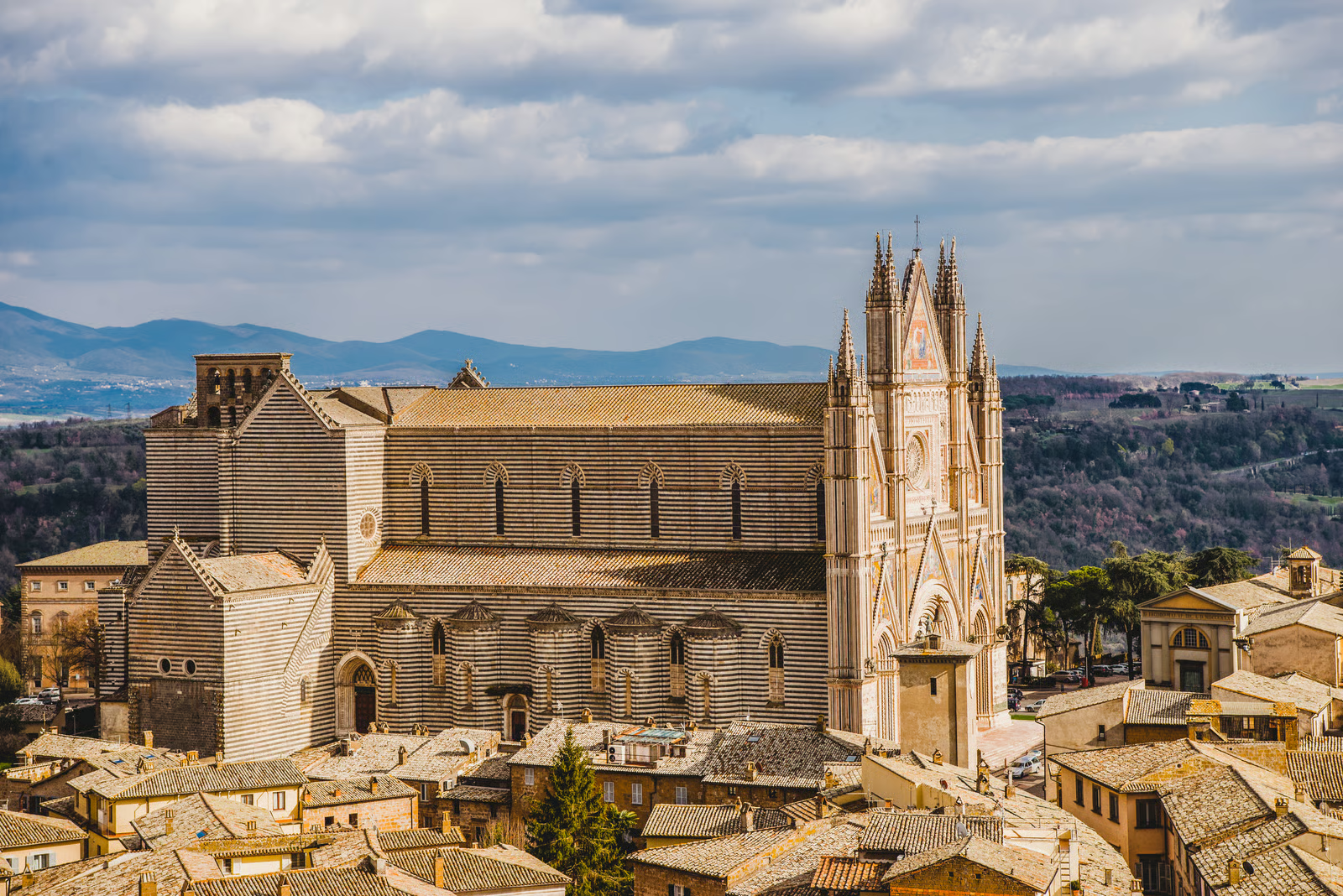
Its façade, begun around 1310 by the Sienese master Lorenzo Maitani, is considered a masterpiece of Italian Gothic art by the Opera del Duomo di Orvieto. It is an enormous monumental composition of marble, bronze and golden mosaics that glows like a jewel at sunset.
But the real treasure lies inside, in the Chapel of San Brizio. Here, as documented by the Italian Ministry of Culture, you will find Luca Signorelli’s masterpiece. Between 1499 and 1504, he completed the fresco cycle begun by Fra Angelico, painting the magnificent Scenes of the Last Judgement.
Powerful bodies, the damned and the blessed, twist and rise with astonishing physical intensity. It is no coincidence that, as the Cathedral’s official website recalls, these frescoes inspired Michelangelo. Visitors almost always spend longer in this chapel than they had planned: some things simply cannot be appreciated in a hurry.
Beneath the rocky plateau, or rather inside it, lies St. Patrick’s Well, the engineering marvel that everyone photographs. Excavated by Antonio da Sangallo the Younger beginning in 1527, it is 54 metres deep and features a double-helix staircase with 248 steps, according to CoopCulture. The two stairways never intersect, allowing those descending to collect water to avoid those climbing back up. Walking down is a little journey into the heart of the rock.
And then there is the wine. Orvieto is one of Umbria’s oldest wine-producing areas, and its Orvieto Classico DOC is made primarily from Grechetto and Trebbiano grapes, as explained by the Consorzio Tutela Vini Orvieto. It is a fresh, mineral white wine, shaped by the area’s volcanic soils and perfect for enjoying in the evening while gazing beyond the stone parapets.
One practical note before setting off: you will hear about the funicular connecting the railway station to the top of the plateau, but always check whether it is operating before travelling, as services may be suspended for maintenance. For a climb without unexpected complications, our preferred option remains the same: the e-bike.
Amelia, Southern Umbria's Best-Kept Secret and Its Ancient Walls
If Todi and Orvieto are the two great highlights, Amelia is the quieter note that few people know, and that is exactly why it is worth the journey.
Cycling to Amelia is a detour for travellers who want to go beyond the names found in every guidebook. Here, the first thing that catches your eye is the polygonal walls, among the oldest in Umbria. These imposing stone blocks, fitted together without mortar, are older than any cathedral. According to the official Turismo Amelia website, the walls once enclosed an area of approximately 20 hectares.
Touch those stones and you are touching a pre-Roman world, a time when this hill was already a fortress. Amelia is the hidden side of Southern Umbria, and for travellers looking for authentic encounters rather than queues, it often becomes one of the most memorable surprises of the trip.
About fifteen kilometres from Amelia, along an undulating country road winding through olive groves, Lugnano in Teverina preserves one of Southern Umbria’s finest examples of Romanesque architecture: the Collegiate Church of Santa Maria Assunta. Built between the eleventh and twelfth centuries, with a portico documented as early as 1230, the church features a façade adorned with a rose window framed by two tiers of small columns, an eagle at the top and symbols of the Evangelists carved into the arches. It is a theological story told in stone, described by the Umbria Region’s official tourism portal as one of the jewels of Umbrian Romanesque architecture. But it is the interior that makes you linger.
The fourteenth-century Cosmatesque-style floor, with geometric patterns of recycled multicoloured marble inspired by the workshops of the Roman Cosmati family, covers the entire nave and retains all its decorative power.
In the crypt, a fifteenth-century alabaster crucifix remains an object of devotion. In the apse, a triptych by Nicolò di Liberatore, known as l’Alunno, a fifteenth-century painter from Foligno, adds another masterpiece of Umbrian art to a place already rich in treasures.
Completing the picture is a Werle organ dating from 1756, built by a Tyrolean workshop. It is a detail appreciated by connoisseurs, but those who know about it will happily cycle all this way just to see it.
For cyclists arriving from Amelia, the route takes you through around fifteen kilometres of gently rolling hills with a couple of steeper stretches: nothing an e-bike cannot handle.
How to Explore Southern Umbria by Bike: Cycling Routes and the Right Travel Style
How do you bring all these destinations together on two wheels? Cycling through Southern Umbria follows a natural backbone: the River Tiber.
The Tiber Cycle Route accompanies cyclists through Umbrian towns and, along its southern stretch, approaches Todi before climbing towards Prodo and finishing in Orvieto, on a section described by the Italia.it tourism portal as the most demanding of the entire route. It is the natural link between the area’s two major hilltop cities.
There is also a longer-distance option, the Romea Tiberina Cycle Route, also known as Bicitalia 5. According to Bicitalia, this route continues from Perugia through Marsciano, Todi, Orvieto and Orte. It provides the ideal framework for an extended cycling journey, moving from one hilltop destination to another while following the course of the river.
There is one important distinction to make. This is not the same journey through officially recognised historic villages that we have described elsewhere.
If you are looking for small towns awarded the Orange Flag or included in the list of Italy’s Most Beautiful Villages, that is another side of Umbria. You can discover it in our article about cycling through Umbria’s villages and, for a more intimate experience, in our guide to Montone and the Upper Tiber Valley by bike, where the valley floors are gentle and the villages are tiny.
The Southern Umbria we are exploring here offers a different kind of experience: major cities of art, monumental cathedrals and genuinely challenging climbs. Neither better nor worse, simply different. It is worth knowing before choosing the journey that suits you best.
The ideal travel formula is designed around this landscape: an e-bike to make the hills manageable, a self-guided itinerary with a GPX route so you can stop whenever you like, and luggage transfers to take the weight off your shoulders.
This is the way we love to travel: free to spend as long as you wish admiring a chapel, but with someone available to help if anything does not go according to plan.
When to Visit Todi and Orvieto: Planning Your Trip
The two best seasons for cycling in Southern Umbria are spring and autumn.
In spring, the countryside surrounding the hilltop towns is lush and green, and the temperatures invite you to enjoy long, unhurried rides. In autumn, the light turns golden, much like the façade of Orvieto Cathedral, and the weather is ideal for tackling climbs without struggling in the heat.
Summer, with its steep, sun-exposed roads climbing the tufa cliffs, is best avoided if you have the flexibility to choose another season.
The secret is to plan ahead. The best cyclist-friendly accommodation, offering secure bike storage and e-bike charging facilities, is often booked months in advance, especially during the most popular periods.
We work with a network of accommodation providers specifically suited to cycle tourists, and the earlier you plan, the more options you will have.
If you would prefer a complete overview before deciding when to visit, how to get around and what type of cycling holiday to choose, you will find everything in our guide to cycling tourism in Umbria. It is the perfect starting point for planning your adventure.
Your Journey Through the Heart of Umbria
At the end of a journey like this, you head home with your phone full of photographs of tufa cliffs silhouetted against the light, and the feeling that you have discovered a less obvious corner of Italy.
But what makes the experience truly rewarding is something else: not having to figure everything out on your own. Which destination to visit on which day, how to manage the climbs without exhausting yourself, where to stay at the foot of the cliffs. That is exactly the point: Southern Umbria becomes easy to explore when someone has already connected the dots for you.
If you like the idea of setting off on a tried-and-tested journey, take a look at our “In the Heart of Umbria” experience among our cycling holidays. It is designed for travellers who want to discover Umbria’s cities of art without worrying about logistics.
Would you prefer something tailored to your own pace, an extra stop to admire a work of art, or perhaps a winery visit along the way? Tell us what you have in mind and we will create the journey together, with a fully organised, tailor-made itinerary and nothing for you to worry about.
Contact us to plan your personalised cycling adventure.
FAQ – Cycling in Southern Umbria
What Should You See in Todi?
The heart of the city is Piazza del Popolo, considered one of Italy’s most beautiful medieval squares by Lonely Planet, overlooked by the Cathedral with its Romanesque façade.
Do not miss the Church of San Fortunato, home to the crypt of Jacopone da Todi and a panoramic bell tower, as well as the Temple of Santa Maria della Consolazione just outside the city walls, a Renaissance church identified by the Touring Club Italiano as the symbol of Todi.
What Should You See Inside Orvieto Cathedral?
The Gothic façade, begun around 1310 by Lorenzo Maitani, is considered a masterpiece of Italian Gothic art by the Opera del Duomo di Orvieto.
Inside, the Chapel of San Brizio houses Luca Signorelli’s masterpiece. Between 1499 and 1504, he completed the fresco cycle depicting the Scenes of the Last Judgement, as documented by the Italian Ministry of Culture.
Do You Need an E-Bike to Visit Todi and Orvieto?
An e-bike is highly recommended. Todi and Orvieto are perched on rocky outcrops, and the final climbs are demanding. According to Komoot, a route connecting the two cities involves more than 1,100 metres of elevation gain.
Electric assistance turns those steep climbs from a struggle into part of the experience. If you do not bring your own e-bike, you can rent one through our e-bike rental service.
How Long Is the Todi–Orvieto Cycling Route?
One cycling route connecting Todi and Orvieto covers approximately 51.7 kilometres with more than 1,100 metres of elevation gain and is classified as difficult on Komoot.
These distances and climbs become much more manageable with an e-bike, especially if you break up the journey with stops in the towns along the way.
Is Todi One of Italy's Most Beautiful Villages?
No, and it is worth clarifying the distinction. Todi is not a small, officially recognised village but a fully fledged city of art, with a monumental square, a cathedral and several historically significant churches.
It belongs to a different category from villages awarded the Orange Flag, such as Montone. Both are worth visiting, but they reveal two very different sides of Umbria.
Sources Cited
- Istat — Il turismo culturale in Italia — https://www.istat.it/it/files/2023/10/Il-turismo-culturale-in-Italia_Ebook.pdf
- Lonely Planet Italia — Cosa vedere a Todi — https://www.lonelyplanetitalia.it/articoli/citta-del-mondo/cosa-fare-cosa-vedere-todi-umbria
- Touring Club Italiano — Todi — https://www.touringclub.it/destinazioni/todi
- Los Angeles Times (1992) — Todi, città sostenibile — https://www.latimes.com/archives/la-xpm-1992-03-01-tm-5691-story.html
- Touring Club Italiano — Cosa vedere a Orvieto, su e giù dalla rupe di tufo — https://inviaggio.touringclub.it/consigli-di-viaggio/cosa-vedere-a-orvieto-su-e-giu-dalla-rupe-di-tufo
- Opera del Duomo di Orvieto — La facciata — https://www.duomodiorvieto.it/duomo-di-orvieto/la-facciata
- Ministero della Cultura — Museo dell'Opera del Duomo (MoDO) di Orvieto — https://cultura.gov.it/luogo/museo-dell-opera-del-duomo-modo
- Opera del Duomo di Orvieto — La Cappella di San Brizio — https://www.duomodiorvieto.it/duomo-di-orvieto/la-cappella-di-san-brizio
- CoopCulture — Pozzo di San Patrizio — https://www.coopculture.it/it/poi/pozzo-di-san-patrizio
- Consorzio Tutela Vini Orvieto — Orvieto DOC — https://www.orvietodoc.it
- Turismo Amelia — Le mura poligonali — https://www.turismoamelia.it/it/esplora-amelia/le-mura-poligonali
- Italia.it (ENIT) — Ciclovia del Tevere in bici tra le città umbre — https://www.italia.it/it/umbria/cosa-fare/ciclovia-tevere-bici-citta-umbre
- Bicitalia / FIAB — BI5 Ciclovia Romea Tiberina — https://www.bicitalia.org/it/bicitalia/gli-itinerari-bicitalia/130-bi5-ciclovia-romea-tiberina
- Komoot — Todi-Orvieto in e-bike — https://www.komoot.com/it-it/tour/988952997
- UmbriaTourism (Regione Umbria) — Chiesa di Santa Maria Assunta, Lugnano in Teverina — https://www.umbriatourism.it/it/w/chiesa-di-santa-maria-assunta-lugnano-in-teverina