Every July weekend, the question is the same: can you still ride a bike without roasting? In Umbria the answer is yes, as long as you know where to go. Some cycle routes stay cool even when the plains are sweltering: they run along rivers in the shade of the woods, slip into the tunnels of an old railway, or skim the breeze off a lake. We picked five. For each one you’ll find the distance, elevation gain, and surface type, and above all the specific reason it’s cooler there than anywhere else.
1. The Nera Greenway, cool along the river
First, a small misunderstanding about the name: what almost everyone searches for as the “Greenway del Nera” goes by a different name on the official signage. On the Region’s maps you’ll find it as the Ciclovia del fiume Nera (Nera River Cycle Route): as the Umbria Region explains, a route of about 30 kilometers along the left bank of the Nera, touching the villages of Scheggino, Ferentillo, and Arrone. It’s the same route you were looking for, just with the right name on it.
The stretch cyclists love most runs from Sant’Anatolia di Narco to the Marmore Falls: about 28 kilometers, almost entirely flat, with just one climb of a little over a kilometer in the final section, according to Italia.it. The surface is smooth, and you ride across bridges and through old tunnels where vegetation has covered the walls, creating natural decorations. And this is exactly the secret of its coolness: you stay on the valley floor, sheltered by riverside vegetation and the woods of the lower Valnerina, with the river flowing alongside and softening the heat. No nasty climbs, no stretches exposed to the sun for kilometers on end.
If you want to know where to refill your water bottle before setting out, the three villages along the route are also the natural stops for water and coffee: you can break up the ride at an easy pace, never straying far from the shade. And it’s precisely this combination of flat terrain, constant shade, and no traffic that makes this stretch perfect even for those riding with children: minimal effort and high safety. One last piece of context: the Ciclovia del fiume Nera is not an isolated route, but connects to the former Spoleto-Norcia railway and extends the Assisi-Spoleto-Terni cycling axis by almost 100 kilometers, within the national Bicitalia network, again according to the Umbria Region.
The route ends at the Marmore Falls, which deserves its own discussion and to which we’ve dedicated an in-depth article on visiting the falls by bike. And a closing note of honesty: the regional cycling loop is still under construction, and the link between the falls and the center of Terni is not yet complete. As the Umbria Region explains, a program agreement worth 2.5 million euros has been signed to overcome this problem and give continuity to the Nera cycle route. In the meantime, the stretch along the river remains one of the most pleasant summer rides in the region.
2. The former Spoleto-Norcia railway: the cool of the tunnels
If there’s a place where the heat simply doesn’t enter, it’s inside the tunnels of an old mountain railway. The former Spoleto-Norcia railway was a historic 51-kilometer line, opened on November 1, 1926 and closed on July 31, 1968, now largely converted into a greenway, as documented by the City of Spoleto’s information sheet: the conversion, together with the Spoleto-Assisi cycle route, won the Italian Green Road Award in 2015.
The reason this route is cool even at the end of July lies entirely in its railway nature. To get the trains up to Norcia, the engineers of a century ago dug tunnels and raised viaducts, keeping the maximum gradient at 4.5%, according to the City of Spoleto: this means you climb without harsh ramps, immersed in the woods, and every time you enter a tunnel the temperature drops by a few degrees. One of the longest tunnels on the route measures almost two kilometers of cool, damp darkness: bring proper lights, because it isn’t illuminated. The rising altitude does the rest, and the difference from the valley’s sultry heat is unmistakable.
The route is divided into four sections of very different character, from the most demanding and structure-rich near Spoleto to the scenic stretches toward the Sibillini, again as described by the City of Spoleto. And here comes an important warning, from fellow travelers rather than guides promising what isn’t there: the route cannot be ridden in its entirety without interruption. In particular, the cycle route does not reach Norcia: at a certain point you have to leave the track and complete the last stretch on ordinary roads. Elsewhere too, some segments remain interrupted, partly because of the 2016 earthquake, and before planning an end-to-end ride it’s best to check the updated status. Don’t expect a clean end-to-end ride: think of it instead as a collection of cool stretches to savor one at a time, choosing the one that is open and in good condition.
3. The Tiber Cycle Route in the Upper Tiber Valley
Farther north, the Tiber is still a young river, flowing calmly among the fields. The first stage of the Ciclovia del Tevere connects San Giustino to Città di Castello and continues to Umbertide, winding through the gentle scenery of the Upper Tiber Valley, as Italia.it describes. These are the opening kilometers of the great cycling corridor that follows the river, and they are also among the most relaxing.
The numbers that matter: the stage is 44.5 kilometers long and practically flat, with minimal elevation change (around 80 meters of climbing and 150 of descent), on a mixed surface of asphalt and compact gravel, largely closed to traffic, according to the Ciclovia del Tevere track on Komoot. In other words: a smooth-running route, suitable even for a hybrid bike and the legs of the whole family, with no climbs to take your breath away. The coolness here comes from water and trees: you ride close to the Tiber in its northernmost stretch, with riverside vegetation shading the embankment and the constant closeness to the river lowering the perceived temperature compared to the surrounding hills. The clear, crystalline waters of this stretch, Italia.it reminds us, are part of the pleasure: they accompany you for almost the entire route.
It’s a ride that lives on small things: a shady ford, a heron rising from the reeds, a stop in Città di Castello with its Renaissance squares. The stage ends in Umbertide, in the heart of northern Umbria, and is an excellent introduction to the area we described in our guide to cycling the Upper Tiber Valley. If you want to go farther, from here the cycle route continues south along the river, but this first stage alone is worth a cool day out.
4. Lake Trasimeno, the cooling breeze
There is a kind of coolness that comes neither from the shade of the woods nor from altitude, but from the still water of a large lake. Trasimeno, the largest lake in peninsular Italy, works like an enormous natural air conditioner: its mass of water generates a constant breeze that tempers the summer heat along the entire cycling perimeter. The northern sector, in particular, alternates open, breezy lakeshore stretches with shaded passages among woods and olive groves on the hills sloping down to the shore, following the route of Castiglione del Lago, Tuoro, Passignano, and Magione.
To give you a concrete idea of the distances: from Tuoro sul Trasimeno starts a 34.6-kilometer loop with just 70 meters of elevation gain, according to Komoot, perfect for a light half-day; those with the legs and desire to ride around the entire lake can instead take the variant from Magione, 62.9 kilometers with about 350 meters of total elevation gain, again according to Komoot. In recent years the route has become increasingly continuous thanks to regional works: the Umbria Region has funded the completion of the loop between Panicarola and Castiglione del Lago, while in the Magione area the continuity of the cycling route has been secured, with a new stretch even equipped with an e-bike charging station, as documented by the Umbria Region itself.
A recent award confirms this cycling vocation: in June 2026 the Ciclovia del Trasimeno won the Green Road Award, the “Italian Oscar of cycle tourism,” selected from 33 applications submitted by Italian regions, as reported by La Nuova Ecologia.
Trasimeno deserves much more than a paragraph, and not by chance we’re dedicating a full article of its own to it. Here it’s enough to point it out for what it is in high summer: one of the few places in Umbria where, even at noon, a thread of cool air always blows in from the water.
5. Coming soon: the former Fossato di Vico-Umbertide railway
The last route is more a promise than a finished path, and deserves to be kept an eye on by those who love cool rides. On the right-of-way of the former Ferrovia Appennino Centrale, the line closed in 1945, a new cycle path of about 52 kilometers is being built that will connect Umbertide, Gubbio, and Fossato di Vico, running along the Assino river valley, with 8 bridges and 2 tunnels, according to the Umbria Region. It’s exactly the kind of infrastructure that promises coolness: valley floor along a watercourse, panoramic bridges, and tunnels that cut through the heat.
We say promise because it’s still a construction site. When it first opened, only part of the route was an actual cycle path, and completing the 52 kilometers will take time. Before aiming for a summer ride, check the status of the works. But it’s undoubtedly a route to mark in your calendar, one that in a few seasons could become the new cool greenway of the Gubbio area.
How to choose your cool ride (and what to pack)
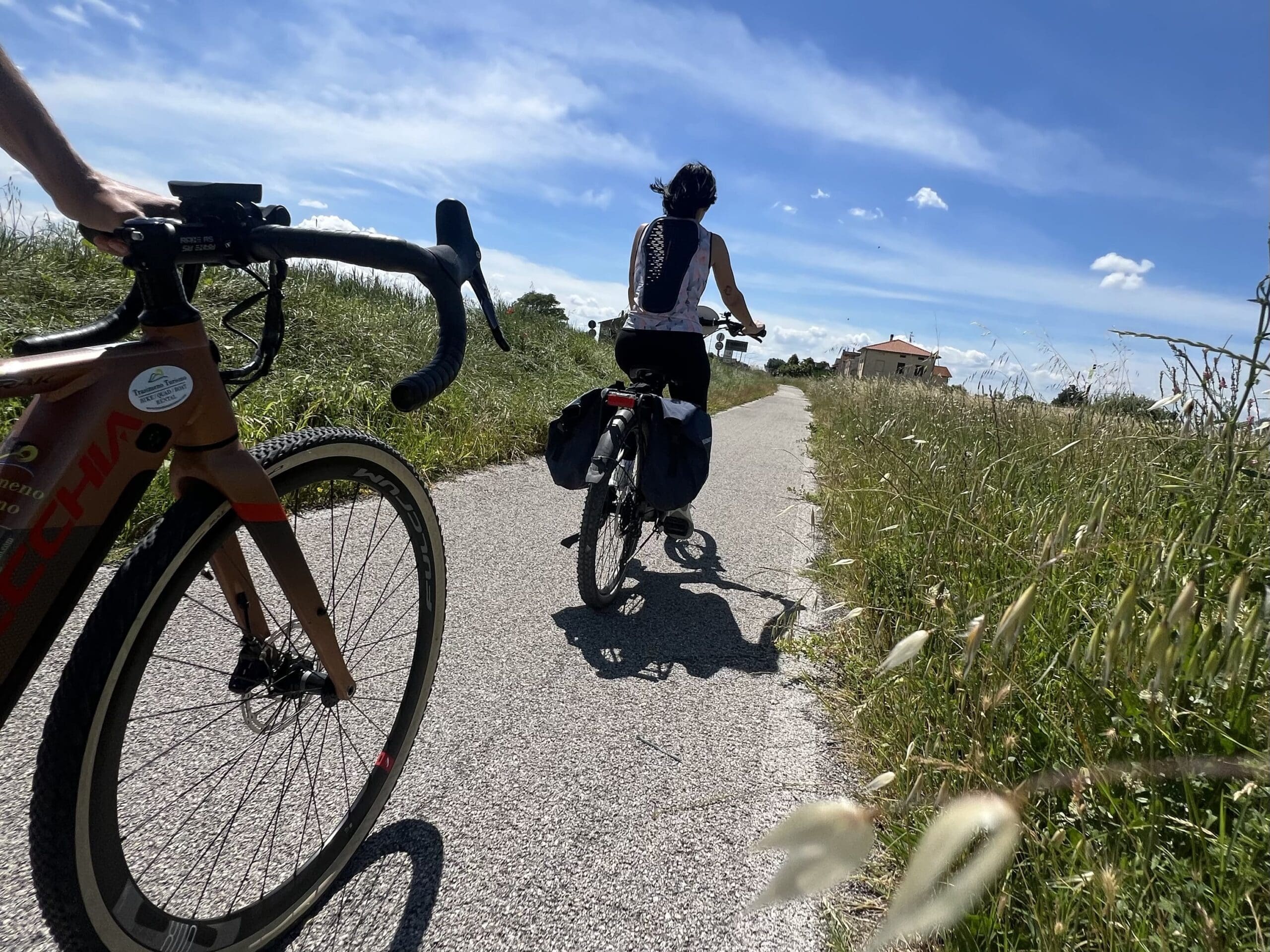
Five routes, five different ways to beat the heat: now all that’s left is to choose yours. If you love numbers and want to go farther without suffering, the e-bike is the best summer ally: it lets you cover more kilometers while staying cool, because you pedal with less effort and produce less heat, and it leaves you energy to enjoy the scenery instead of counting the ramps. The rest is common sense from an experienced cycle tourist: set out in the cool hours of the morning or late afternoon, always carry two water bottles and use the fountains in the villages along the Nera and the Tiber to refill them, and plan your shady stops before you even leave.
If you’re traveling with children, the choice is even simpler: the flat, shaded stretches along the Ciclovia del fiume Nera and the Ciclovia del Tevere are the most suitable, because they combine no traffic, constant shade, and nearby water, the three ingredients that make a family ride a pleasure rather than an ordeal.
And if you’d rather have someone else take care of the logistics, the consortium has built some turnkey itineraries around these landscapes. Among our bike trips you’ll find the “From Spoleto to Marmore” tour, which combines the magic of the Spoleto-Norcia tunnels with the coolness of the Ciclovia del fiume Nera, and the “Along the Tiber River” tour, designed precisely for those who want to ride in the shade of the water. For families there’s the “Tiferno wild in famiglia” package, designed around a child-friendly pace and safety. If you don’t want to bring your own bike, take a look at our e-bike rental, and for sleeping along the route we rely on a network of accommodations equipped for those traveling on two wheels. Want a cool ride built around your dates and your pace? Write to us for a tailor-made itinerary: the calendar takes care of the heat, and we take care of the rest.
And if you’re still entering the world of Umbrian cycle tourism, start with our guide to cycling in Umbria.
FAQ — Cool Cycle Routes in Umbria
What is the coolest cycle route in Umbria in summer?
It depends on the kind of coolness you’re after. For constant shade and the closeness of water, the Ciclovia del fiume Nera along the Valnerina is unbeatable, with its roughly 30 almost entirely flat kilometers through woods and vegetation-covered tunnels, as the Umbria Region describes. For the cool of tunnels and altitude, the former Spoleto-Norcia railway wins; for a breeze, Lake Trasimeno.
Is the Nera Greenway flat and suitable for children?
Yes. The most popular stretch, from Sant’Anatolia di Narco toward the Marmore Falls, is almost entirely flat for about 28 kilometers, with just one short climb of a little over a kilometer in the final section, according to Italia.it. The smooth surface, shade, and lack of traffic make it one of the best routes for anyone riding with children.
Can the former Spoleto-Norcia railway be ridden by bike?
Largely yes, but not from one end to the other without interruption. The historic 51-kilometer line, with a maximum gradient of 4.5%, has been almost entirely converted into a greenway, but the City of Spoleto notes that it cannot be ridden in its entirety without interruption, partly because of the effects of the 2016 earthquake. In particular, the cycle route does not reach Norcia: the last stretch requires ordinary roads. Always check the updated status of individual sections before setting out, and remember lights for the unlit tunnels.
Are there cycle routes along a river in Umbria?
Yes, and they are among the coolest. The Ciclovia del fiume Nera follows the left bank of the Nera for about 30 kilometers, touching Scheggino, Ferentillo, and Arrone (Umbria Region), while the first stage of the Ciclovia del Tevere connects San Giustino, Città di Castello, and Umbertide over 44.5 almost flat kilometers along the river (Komoot).
Do I need an e-bike for these routes?
No, but it helps, especially in summer. Almost all of these routes have modest elevation changes and can be tackled with a regular or hybrid bike. An e-bike is useful if you want to cover longer distances without building up heat and fatigue, or if you’re taking on the gradual climb of the former Spoleto-Norcia railway. If you don’t have an e-assist bike, you’ll find everything on the e-bike rental page.
Sources cited
- Regione Umbria: Inaugurato il percorso della Ciclovia lungo il fiume Nera — www.regione.umbria.it/notizie/-/asset_publisher/54m7RxsCDsHr/content/inaugurato-il-percorso-della-ciclovia-lungo-il-fiume-nera-melasecche-ed-agabiti-percorso-strategico-che-prolunga-l-asse-ciclabile-assisi-spoleto-verso
- Regione Umbria: Ciclovie, 2,5 milioni di euro per la realizzazione degli interventi — www.regione.umbria.it/notizie/-/asset_publisher/54m7RxsCDsHr/content/ciclovie-2-5-milioni-di-euro-per-la-realizzazione-degli-interventi-al-via-gli-accordi-di-programma
- Italia.it (ENIT): Percorso ciclabile delle Gole del Nera — www.italia.it/it/umbria/cosa-fare/percorso-ciclabile-gole-del-nera
- Comune di Spoleto: Ex Ferrovia Spoleto-Norcia — www.comune.spoleto.pg.it/it/vivere/ex-ferrovia-spoleto-norcia
- Italia.it (ENIT): Ciclovia del Tevere tra le città umbre — www.italia.it/it/umbria/cosa-fare/ciclovia-tevere-bici-citta-umbre
- Komoot: Ciclovia del Tevere (San Giustino - Città di Castello - Umbertide) — www.komoot.com/it-it/highlight/3118896
- Regione Umbria: Oltre 3 mln di euro per l'anello ciclabile del Trasimeno — www.regione.umbria.it/notizie/-/asset_publisher/54m7RxsCDsHr/content/ambiente-e-sviluppo-assessore-cecchini-oltre-3-mln-euro-per-anello-ciclabile-trasimeno-e-altri-interventi-strategici-in-aree-attrazione-naturale
- Regione Umbria: Progetto integrato Trasimeno, completato l'anello ciclabile nel territorio di Magione — www.regione.umbria.it/notizie/-/asset_publisher/54m7RxsCDsHr/content/progetto-integrato-trasimeno-sopralluogo-assessore-morroni-nel-territorio-di-magione-completato-anello-ciclabile-e-riqualificata-area-depuratore-in-di
- Komoot: Pista ciclabile del Lago Trasimeno (varianti da Tuoro e da Magione) — www.komoot.com/it-it/highlight/333238
- Regione Umbria: In autunno tutti in bici sulla ex ferrovia Fossato di Vico-Umbertide — www.regione.umbria.it/dettaglionotizie/-/asset_publisher/lU1Y2yh4H8pu/content/in-autunno-tutti-in-bici-sulla-ex-ferrovia-fossato-di-vico-umbertide-assessore-melasecche-dalla-connessione-fra-reti-ciclabili-comunali-e-rete-ferrovi