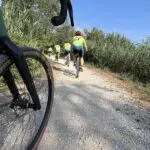
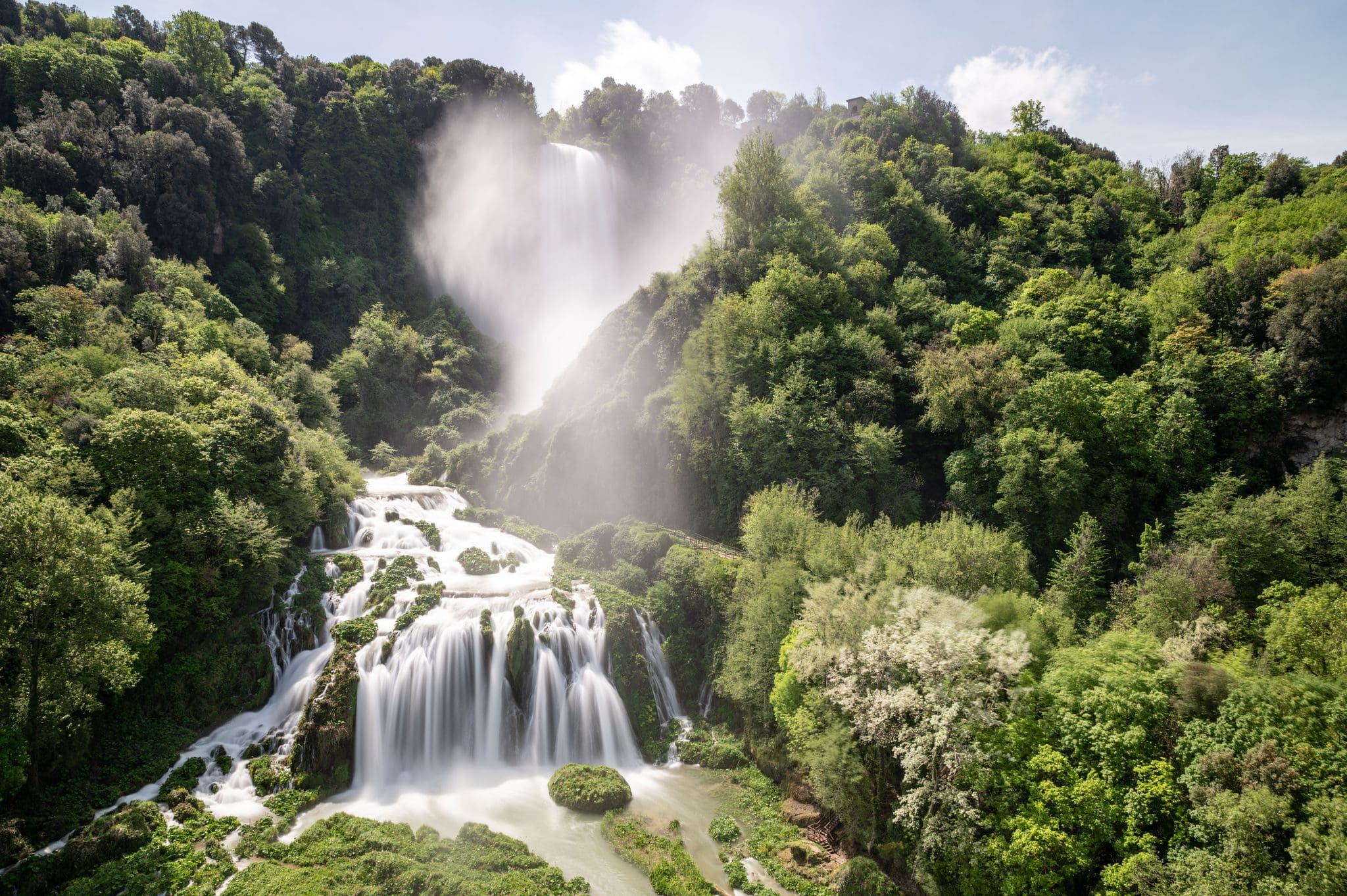
Umbria by bike is a small, green and surprisingly quiet region, where the landscape makes itself felt with every pedal stroke and stays with you long afterwards. Its secondary roads tell its story better than any guidebook: the ones that gently climb through the olive groves between Bevagna and Montefalco, far from the main routes, where all that remains is the rhythm of the ride and a bell tower at the end of the climb.
Italy’s green heart, beyond the slogan
Rolling hills stretch towards the horizon, rows of olive trees trace the contours of the land, and solitary cypresses mark the entrance to a farmhouse. Then there are Romanesque parish churches at the edge of fields, hilltop villages that suddenly appear around a bend, wineries, and art that surprises you at every stop without making a fuss. This is central Italy in its more intimate form, where everything is within reach of your pedals and nothing is ever too far away.
But for those travelling by bicycle, beauty is not measured only with the eyes. Cyclists experience the road metre by metre, outdoors and exposed to everything: they feel the traffic, look for a table at a trattoria at two in the afternoon, and hope the viewpoint at sunset will not be crowded. For a cyclist, the rhythm of a place matters just as much as the climbs and the views.
Room to ride
According to ISTAT, in 2024 Umbria recorded 6.75 million tourist overnight stays across a territory of just 8,464 square kilometres. That is fewer than 800 overnight stays per square kilometre — a figure that, for cycling tourists, translates into very tangible things. Quiet secondary roads, less traffic along the way, fewer “fully booked” signs at the entrance to villages, and a greater chance of finding a table at a local restaurant even without a reservation. In practice, these are the conditions that make a cycling holiday enjoyable.
There is also an impact on your wallet. In December 2025, during the low season, the average price of a room in Umbria was €119.56, according to the Ministry of Tourism. This is a monthly figure, not an annual average, but it remains a sign of relatively moderate prices, consistent with everything else. Also in 2024, according to ISTAT data, overnight stays in Umbria increased by 5% compared with the previous year. The region is growing, and for now it is doing so without becoming overcrowded.
Ten villages with the Orange Flag
And this tranquillity coexists with a widespread beauty, found above all in the small inland towns. The Touring Club Italiano awards these villages its Orange Flag, and there are ten in Umbria: the Touring Club describes them as “authentic places where art, nature, good food, sustainability and hospitality express the most genuine culture of the area.”
Ten certified villages in a region with just over ninety municipalities mean, on average, almost one in every nine. It is a widespread network of authenticity, spread across a compact area that you can explore slowly, without crowds filling every alleyway. By bike, the kilometres between one village and another pass almost unnoticed. Which villages they are and how to connect them into a single itinerary is explained in our guide to cycling through the villages of Umbria.
What to see in Umbria by bike
Imagine an ideal week, measured in emotions rather than kilometres. Start with the Sagrantino Wine Route around Montefalco, where the hills are covered in vineyards and every winery is a stop steeped in history, with wine bringing those same hills to the table, glass after glass. We have dedicated a separate itinerary to this area: the Sagrantino Wine Route and Umbria’s wineries.
Then there is the world of pilgrimage routes, which gives Umbria its reputation as a land of spirituality. Cycling along the Way of St. Francis means travelling through woods, hermitages and silence that words struggle to convey. Those looking for a more relaxed pace will find the Lake Trasimeno loop an almost completely flat route, also perfect for an e-bike and ideal for a family day out. And then there are the villages: cycling between the medieval villages of the Umbrian Valley is the most natural way to understand this land. The Touring Club Italiano puts it well: “if Umbria is the green heart of Italy, the Umbrian Valley is undoubtedly the beating heart of the region: the best way to appreciate it is on an e-bike.”
If you need an overview of routes, the best times to travel and practical advice, we have collected everything in our complete guide to cycling tourism in Umbria . And if you would rather skip the planning and simply ride, you can already discover our cycling tours in Umbria, designed for every pace and every level of cyclist.
In search of space and silence: a growing trend in Europe
This desire for space and slowness is shared by a growing number of travellers across Europe. Slow travel in central Italy is now a structural trend, recognised by tourism institutions themselves. ENIT, Italy’s national tourism agency, confirms this when it notes that “many international tourists prefer new outdoor experiences and discovering destinations that offer an alternative to major cities.”
The cycling tourism world is even further along this path. In its report on the five cycling tourism trends for 2026, the European Cyclists’ Federation describes “general tourism trends oriented towards quiet, off-the-beaten-track and authentic experiences.” Cyclists are among the first to appreciate what Umbria has always offered; the rest of the world is only now rediscovering it.
Who is Umbria by bike really for?
In the end, it all depends on what you are looking for. Umbria by bike is the right trip for those who have already experienced the most famous destinations in Southern Europe and now want somewhere that has not yet been worn down by postcards; for international travellers drawn to the authentic soul of Italy, away from the crowds, among wineries and villages that have barely changed their appearance; for couples who cycle side by side during the day and stop for a proper meal together in the evening; and for anyone who loves travelling independently but still wants a support network behind them.
And then there are those who have always thought, “climbs aren’t for me.” E-bikes have made possible what once seemed too demanding: in Northern European countries, assisted cycling is already the norm, and here it makes even the longest climb towards a hilltop village feel manageable. With a motor that supports you, you reach the top with enough breath left to enjoy the view.
There is usually one question left: what about Tuscany? It is beautiful and loved around the world, and it shares hills, stone villages, wine and art with Umbria. The main difference is the pace, the same distinction captured by Lonely Planet when it describes Umbria as “the quieter, less-travelled neighbour.”
Zero hassle: authenticity is also a service
For a traveller, however, “authentic” should never mean “you’re on your own.” The most genuine experience is one where you can focus only on what really matters, the landscape, the flavours, the encounters, without the burden of managing the logistics. And that is exactly what we do. The Umbria we offer combines the two: bicycles and e-bikes selected to fit you, luggage transfers from one village to the next, GPX tracks already loaded onto your phone, support throughout the route, and carefully selected hotels waiting specifically for you. Here, authenticity comes through attention to detail and a turnkey service, as well as through geography.
If this is the kind of trip you have in mind, take a look at our turnkey cycling holidays in Umbria and tell us how you imagine your journey. We’ll take care of the rest.
Frequently Asked Questions
What should I see in Umbria by bike?
The four main highlights are the Sagrantino Wine Route around Montefalco, the Way of St. Francis through woods and hermitages, the Lake Trasimeno loop, almost completely flat and excellent for families, and the Umbrian Valley with its medieval villages. They can be connected within relatively short distances, making it easy to build a multi-day itinerary without ever having to travel too far.
Is Umbria by bike suitable for people who are not very fit?
Yes, absolutely. Thanks to e-bikes, the hills become accessible to everyone, and many routes, such as the Lake Trasimeno loop, are gentle and suitable for families as well. Our days in the saddle are tailored to each traveller, generally covering between 40 and 60 kilometres, with the option to make them shorter or longer depending on how you feel.
What is the best time of year to cycle in Umbria?
Spring and early autumn are ideal: mild temperatures, long daylight hours, intense colours and fewer crowds than in the height of summer. These are also the seasons when the vineyards and olive groves are at their best.
How many days do you need for a cycling trip in Umbria?
It depends on how long you want to stay. A long weekend is enough to explore a single area, such as the Umbrian Valley or Lake Trasimeno. With a week, you can combine several highlights, vineyards, a pilgrimage route and a lake, without ever having to make long transfers, because distances here remain manageable and each stage is within easy reach of the next. In the end, the number of days is determined by how much time you want to spend off the bike, not how much time you want to spend in the saddle.
Is Umbria or Tuscany better for cycling?
Umbria and Tuscany have many similarities. Umbria, however, offers a slower pace, quieter roads and less crowded villages, giving you the feeling of being in a corner of Italy that is still relatively undiscovered. For many travellers, this is what makes the difference.
Sources cited
- ISTAT: Tourist flows, Year 2024 (overnight stays in Umbria, change from the previous year) — www.istat.it/wp-content/uploads/2026/03/Statistica-Today_Turismo-2024.pdf
- Ministry of Tourism: “How Tourism in Italy Is Doing”, December 2025 infographic (average room price in Umbria) — www.ministeroturismo.gov.it/wp-content/uploads/2026/01/Infografica_dicembre25.pdf
- ENIT: Italian Tourism Trends, ITB Berlin 2025 — www.enit.it/it/enit-allitb-di-berlino-presentati-i-dati-sui-trend-del-turismo-italiano
- European Cyclists’ Federation (ECF): 5 Cycling Tourism Trends in 2026 — www.ecf.com/en/news/5-cycling-tourism-trends-in-2026
- Touring Club Italiano: Orange Flags (certified villages) — www.touringclub.it/notizie/bandiere-arancioni/quattro-nuove-bandiere-arancioni-e-277-confermate-sono-281-i-borghi-premiati-dal-touring-in-tutta-italia
- Touring Club Italiano: Cycling in Umbria by e-bike (Umbrian Valley, green heart) — inviaggio.touringclub.it/consigli-di-viaggio/vacanze-italiane-umbria
- Lonely Planet: Umbria — www.lonelyplanet.com/destinations/italy/umbria-and-le-marche