
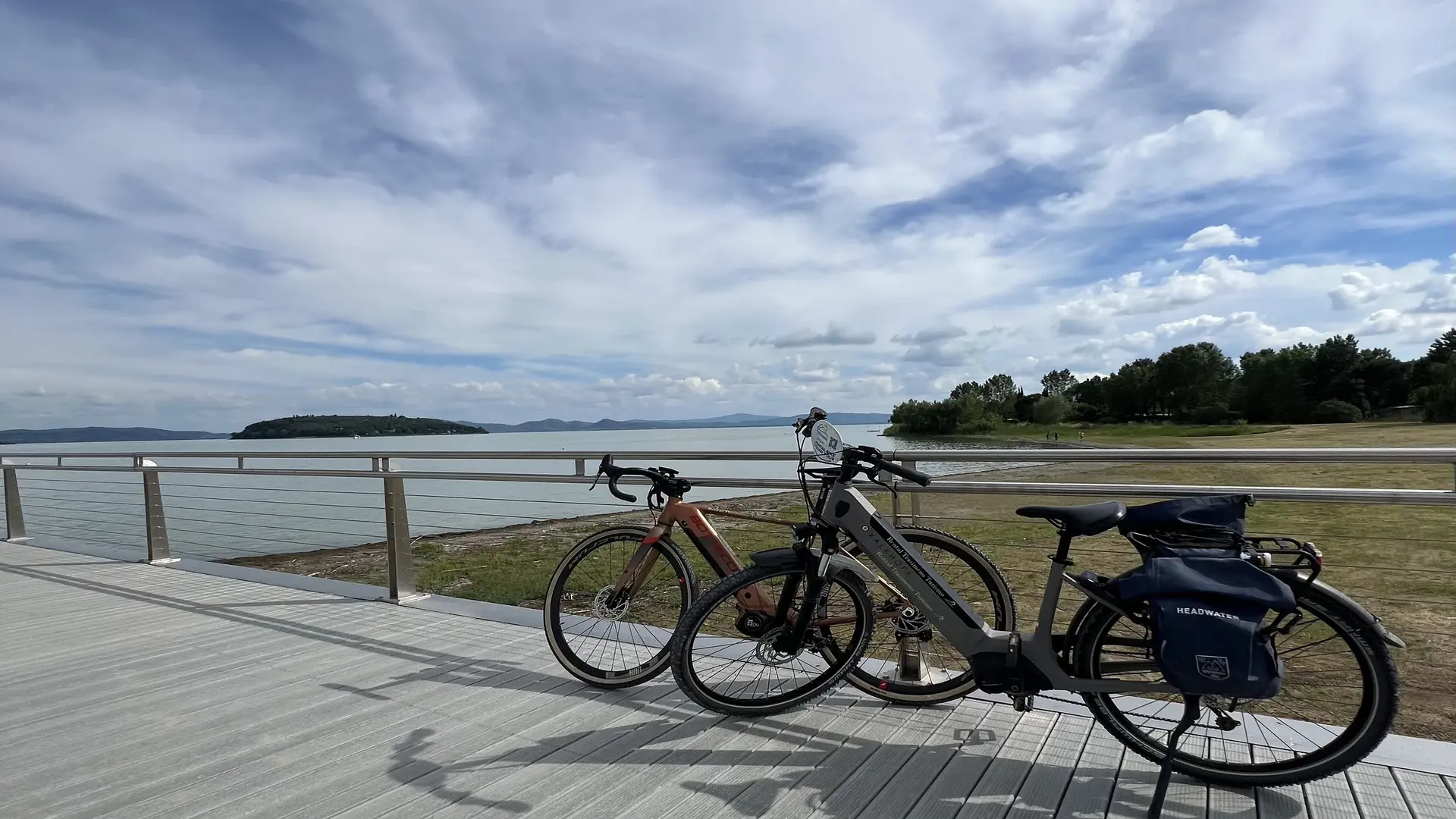
Lake Trasimeno is best explored from the saddle: a circular route through reed beds, beaches, fishing villages and castles overlooking the water, to be enjoyed at a leisurely pace all around its shores. It’s a ride for those who love cycling without rushing, with plenty of time to stop by the lakeside and let the wind rustling through the reeds be the loudest sound around. And since June 2026, this cycling loop has an award to prove its excellence: the route won the Green Road Award, known as the “Italian Oscar of cycle tourism”, at a ceremony held in Sanremo (Umbria Region). We’re talking about the largest lake in peninsular Italy, covering 128 square kilometres (Umbria Region — Lake Trasimeno Regional Park). The Lake Trasimeno cycling loop stretches for approximately 58 kilometres, with barely noticeable elevation changes, making it ideal for families and couples who want to enjoy cycling without needing the stamina of an athlete. And that promise holds true, although there’s something important you should know: the route isn’t entirely paved, and understanding what the terrain is really like before setting off is the first step towards making the most of your experience.
An award-winning cycling loop: why lake Trasimeno won the 2026 green road award
On 19 June 2026, in Sanremo, the Lake Trasimeno Cycle Route won the eleventh edition of the Green Road Award, an accolade affectionately known in the cycling tourism world as the “Italian Oscar of cycle tourism” (Umbria Region). The award confirms that this route has become a national benchmark: despite competition from the much longer cycle routes of Piedmont and Lazio, which finished second and third, the jury chose Umbria’s remarkable lakeside loop.
The regional councillor explained the reason during the award ceremony: “We’re talking about a circular route offering 360-degree accessibility, allowing visitors to experience the lake by bicycle while passing through villages, natural landscapes and protected areas” (Umbria Region). That is precisely what makes Lake Trasimeno special: it isn’t a route reserved for experienced cyclists, but a welcoming experience for everyone, from grandparents to children. And if you’re looking for Umbria’s most celebrated cycling loop, you now have official confirmation from a national jury.
The official route covers 58.4 kilometres around the lake, passing through the lakeside towns and villages of Passignano sul Trasimeno, Torricella, San Feliciano and Sant’Arcangelo (Umbria Region). It’s a continuous thread connecting beaches, reed beds, castles and fishing villages, and today the route is fully connected. In the municipality of Magione, for example, recent works completed the missing sections with a new 750-metre stretch between San Savino and Dirindello and another 1.6-kilometre section, as part of the €3.3 million Integrated Trasimeno Project (Umbria Region).
What the route is really like: almost flat, but with mixed surfaces
The first thing to know is also the most reassuring: elevation changes are genuinely minimal, with just 100 metres of ascent and 100 metres of descent across the entire loop (Umbria Region – Open Data). In practice, for most of the ride, you’ll have the lake on your left and no serious climbs ahead. That’s why the route is so popular with families.
What brochures often overlook, however, is the surface. The Lake Trasimeno cycle route isn’t one continuous strip of asphalt. According to the Umbria Region’s official technical information, over a distance of 57.2 kilometres, 42% of the route is paved (24.1 kilometres), while 58% consists of unpaved tracks (33.1 kilometres). The route is officially classified as having a “medium” difficulty level, and the recommended bicycles are hybrids or mountain bikes (Umbria Region – Open Data). There’s another important detail: the Region itself describes the route as the “Lake Trasimeno cycle path, which follows almost the entire shoreline, with some sections along ordinary roads” (Umbria Region – Open Data). This means the loop isn’t completely separated from motor traffic: a few short sections are shared with cars on low-traffic roads.
In practical terms, Lake Trasimeno is perfect for families and couples, provided you have the right bicycle. Leave your narrow-tyred road bike and city bike at home: what you need here is a hybrid, a mountain bike or, even better for anyone worried about getting tired, an e-bike that lets you glide effortlessly alongside the reed beds. With wider tyres, those 58 kilometres become a delightful ride around the lake rather than an endurance challenge. And the inclusive approach goes beyond choosing the right bike. According to the Region, the lake is “now fully accessible to people with disabilities” (Sviluppumbria): a destination designed to ensure that nobody is left behind.
Shorter routes for families cycling with children
Fifty-eight kilometres in a single ride can be quite a challenge for little legs. But exploring Lake Trasimeno by bike with your family doesn’t necessarily mean cycling around the entire lake. The Umbria Region itself recommends two shorter circular routes, designed for those who want to enjoy the lake in half a day and return comfortably to their starting point (Umbria Region — Open Data).
The first is the Castiglione–Borghetto loop, covering approximately 20 kilometres and taking around two hours at a relaxed pace. It’s the ideal choice for families with young children, as the route follows the lakeshore, keeping the water constantly in sight. The second is the Tuoro–Passignano loop, a 41-kilometre route that takes approximately three and a half hours. It’s a good compromise for families with older, more experienced children or couples who want to enjoy a full half-day of cycling without completing the entire circuit (Umbria Region — Open Data).
Here’s a tip from those who know the lake well: if you’re unsure about your stamina, choose an e-bike. As part of the recent improvements to the cycling loop, an e-bike charging station has also been installed in the municipality of Magione (Umbria Region). With an e-bike, lakeside breaks become moments of pure relaxation, knowing that electric assistance will help you get back without exhausting yourself. When cycling with young children, the formula is simple: fewer kilometres, more stops for ice cream and more time to watch the herons. Lake Trasimeno rewards those who take their time. If you’d rather leave the planning to someone else, from choosing the best route to finding the right bicycles, that’s exactly where we can help. Take a look at our bike and e-bike rental options, and let’s create a personalised itinerary for your family, from the distance you want to cover to the most suitable bikes for your children’s ages.
Castiglione del Lago: the perfect starting point overlooking the water
If there’s one place to begin your cycling adventure around Lake Trasimeno, it’s Castiglione del Lago. The Umbria Region lists it among the main historic towns of the Regional Park, alongside Passignano (Umbria Region — Lake Trasimeno Regional Park). And as soon as you arrive, you’ll understand why: the village overlooks the water like a balcony, with its ancient walls stretching down towards the lake.
Before getting on your bike, take some time to visit the medieval fortress, known as Rocca del Leone (Lion’s Castle). This impressive stronghold has an irregular pentagonal layout, a triangular tower and distinctive Guelph-style battlements. The fortress can be reached from Palazzo della Corgna through a fascinating covered walkway (Italia.it).
It’s the kind of passageway that makes children’s eyes light up: walking through it feels like stepping into a story about medieval knights. And Palazzo della Corgna is well worth visiting for adults, too. Its eight magnificent rooms preserve fresco cycles by Pomarancio, painted between 1574 and 1590 to celebrate the achievements of Ascanio della Corgna (Italia.it). Then, once your cycling adventure is over and the sun begins to set, Castiglione has one more attraction to offer: its equipped beaches along the northern and southern shores, together with numerous campsites where you can stay (Italia.it). A refreshing swim after a bike ride is the perfect way to end the day. And for children, it’s just the kind of promise that keeps them pedalling all the way to the finish.
Tuoro sul Trasimeno and the traces of Hannibal
Cycling northwards, you’ll reach Tuoro sul Trasimeno, where the lake seems to tell a different story. It was among these hills, in June 217 BC, that one of antiquity’s most famous battles took place: Hannibal and his Carthaginian army ambushed the Romans in a clash that would go down in history. And this isn’t just history to read about: it’s history you can still explore on foot. The municipality has created a route divided into 13 stops, each equipped with information panels explaining the different stages of the battle. The itinerary later became part of the Permanent Documentation Centre on Hannibal (Italian Ministry of Culture). For families, it’s a hidden treasure: a simple break becomes a historical treasure hunt through the battlefield, with children reconstructing Hannibal’s strategy step by step.
At Punta Navaccia, also in Tuoro, another surprise awaits you, this time from a completely different era: Campo del Sole, an open-air museum created between 1985 and 1989 from an idea by Pietro Cascella, together with Mauro Berrettini and Cordelia von den Steinen (Italia.it). The installation consists of 27 sculpted pietra serena sandstone columns, each 4.5 metres tall, arranged in a spiral leading towards a central table featuring a solar symbol (Italia.it). Walking among them with the lake in the background is an unforgettable experience. The columns resemble a little stone forest suspended between land and water, making it the perfect setting for a family photograph that might eventually find its place in a frame at home.
Isola Maggiore: Taking your lakeside adventure onto the water
Lake Trasimeno has three islands, and knowing a little about each of them helps you plan your visit. The most famous, Isola Maggiore, is “a charming fishing village dating back to the 15th century”. Isola Polvese is dedicated to environmental education and has a sailing school, while Isola Minore is privately owned and cannot be visited (Umbria Region — Lake Trasimeno Regional Park). For your cycling day, the island to discover is Isola Maggiore.
You can comfortably explore it on foot in a couple of hours, and it’s the kind of detour that turns a bike ride into a little adventure: leave your bicycle behind, board the ferry and cross the water just as fishermen did six centuries ago. The ferry service is operated by FS Busitalia, with routes connecting Isola Maggiore to Passignano and the Navaccia ferry terminal in Tuoro (FS Busitalia).
However, there’s one important practical detail that could make all the difference to your day. Not all ferry services carry bicycles. Only the departures shown in bold in the official timetable allow bicycles on board; all other services do not (FS Busitalia). As for fares, the lake ticket costs €5.40, with an additional bicycle supplement of €2.20 per day (FS Busitalia). Another detail worth remembering: “the bicycle is considered luggage accompanying the passenger, who is responsible for loading, unloading and looking after it” during the crossing (FS Busitalia). Our advice is simple: check the exact ferry timetable before setting off. If you’re travelling with children, consider leaving the bikes on the mainland and exploring the island on foot before returning to continue your cycling loop.
The regional park and La valle nature reserve: nature for the whole family
Everything you’ve discovered so far — the villages, beaches and islands — belongs to a single protected area: Lake Trasimeno Regional Park. The park extends across five municipalities: Castiglione del Lago, Magione, Passignano, Tuoro and Panicale (Umbria Region — Lake Trasimeno Regional Park). Cycling here means travelling through a protected ecosystem, surrounded by a living landscape of reed beds, wetlands and waterbirds taking flight as you pass.
If you’re travelling with curious children, make sure to include La Valle Nature Reserve, on the lake’s southern shore, in your itinerary. This reserve covers approximately 1,000 hectares along the migratory route connecting Northern Europe to sub-Saharan Africa (Oasi La Valle). It’s a natural airport for birds, where thousands can be seen passing through during migration seasons. The reserve features a bird-ringing station, used to study passerine bird populations, and a wooden walkway leading to a birdwatching observatory (Parks.it). For a child, sitting quietly inside a bird hide and seeing a heron up close can be as exciting as an entire day at an amusement park. And it teaches the importance of respecting nature without the need for lectures. It’s the kind of stop that turns a cycling holiday into an experience your children will remember long after they’ve grown up.
Two more villages worth adding to your trip
Lake Trasimeno’s attractions don’t end at the shoreline. Just beyond the cycling loop, in the surrounding hills, you’ll find two villages that deserve a detour. One important thing to remember, though: these are not stops along the official 58-kilometre cycle route. They’re additional excursions, best reached by car or, for experienced cyclists with plenty of energy and an e-bike, by tackling the climbs into the surrounding countryside.
The first is Panicale, awarded the Orange Flag by the Italian Touring Club and described as having “some of the most beautiful natural panoramic terraces in Umbria” (Touring Club Italiano). It’s a stone-built balcony overlooking the entire lake, offering breathtaking views across the water. The second is Città della Pieve, a medieval town that “impresses visitors with the intense colour of its terracotta” (Touring Club Italiano). It has also received the Orange Flag award “for the preservation of its historic landscape”, as confirmed by Italy’s national tourism portal (Italia.it).
These two villages are the perfect finishing touches to a stay at Lake Trasimeno: two half-day excursions that broaden your horizons and, at sunset, reveal some of Umbria’s most beautiful colours. And if historic villages are your passion, the region has many more waiting to be explored by bicycle, as we explain in our guide to cycling through Umbria’s villages.
How to plan your lake Trasimeno cycling loop
The right bicycle for this adventure is a hybrid, a mountain bike or an e-bike. Forget narrow road-bike tyres, because 58% of the route is unpaved (Umbria Region — Open Data). You can choose the distance that suits you best. The full loop is approximately 58 kilometres, but if you’re cycling with children, you can opt for the shorter Castiglione–Borghetto route, covering around 20 kilometres in two hours, or the 41-kilometre Tuoro–Passignano loop (Umbria Region — Open Data). Whichever option you choose, the elevation gain remains minimal. Here, it’s not the climbs that will slow you down, but the temptation to stop again and again to admire the lake.
As for the best time to visit, Lake Trasimeno is a wonderful cycling destination for most of the year. Spring and early autumn offer beautiful light and ideal temperatures for a family ride. In summer, the breeze coming off the water makes this one of Umbria’s most refreshing cycling routes, with the added pleasure of swimming at Castiglione’s equipped beaches. We can help you arrange everything, from bicycle rental and ferry timetables to selecting the most suitable route. Discover our Lake Trasimeno cycling tours, or get in touch to create your own personalised itinerary, with the right bike for every family member, stops designed around younger cyclists and the freedom to explore without a worry.
If this is your first cycling adventure in the area, our guide to cycling tourism in Umbria will help you prepare. And if you have a particular love for lakes, remember that Trasimeno isn’t the only stretch of water in Umbria worth exploring by bicycle. We’ll soon be dedicating a whole chapter to Lake Piediluco, in Valnerina. The Green Road Award has already recognised the Lake Trasimeno cycling loop. All you need to bring is an extra water bottle and your camera.
FAQ - cycling around lake Trasimeno
Is the Lake Trasimeno cycling loop suitable for children?
Yes, and that’s one of its greatest strengths, provided you choose the right route.
The entire loop has an elevation gain of just 100 metres (Umbria Region — Open Data), so there are no demanding climbs.
For families with young children, however, the shorter Castiglione–Borghetto loop is the better option, covering approximately 20 kilometres in two hours along the lakeshore (Umbria Region — Open Data).
Is the route completely flat and paved?
It’s almost entirely flat, but it isn’t completely paved.
The elevation changes are minimal (+100/−100 metres), but the surface is mixed: approximately 42% is asphalt and 58% is unpaved, with some sections shared with ordinary road traffic.
The route is officially classified as having a “medium” difficulty level (Umbria Region — Open Data).
That’s why a hybrid bike or mountain bike is recommended rather than a city bike with smooth tyres.
How long is the complete Lake Trasimeno cycling loop?
The official route covers approximately 58 kilometres around the lake.
The Umbria Region’s announcement for the Green Road Award gives a distance of 58.4 kilometres (Umbria Region), while the official open-data technical information lists 57.2 kilometres (Umbria Region — Open Data).
In short, plan for approximately 58 kilometres.
Can I take my bicycle on the ferry to Isola Maggiore?
Yes, but not on every departure.
Only the ferry services highlighted in bold in the FS Busitalia timetable allow bicycles on board; other services do not (FS Busitalia).
The fare is €5.40 for the lake ticket, plus a bicycle supplement of €2.20 per day (FS Busitalia).
Your bicycle travels as accompanying luggage, which means you’re responsible for loading, unloading and looking after it during the crossing (FS Busitalia).
Always check the timetable before setting off.
Do I need an e-bike to cycle around Lake Trasimeno?
An e-bike is more of a convenience than a necessity.
With 58% of the route consisting of unpaved surfaces (Umbria Region — Open Data), an e-bike allows you to enjoy the scenery and take as many breaks as you like without worrying about getting tired.
There’s also an e-bike charging station along the loop, in the municipality of Magione (Umbria Region).
For families and couples looking for a relaxed cycling experience, it’s the option we recommend.
Sources Cited
- Regione Umbria — "Oscar italiano del Cicloturismo" (Green Road Award 2026) — https://www.regione.umbria.it/notizie/-/asset_publisher/54m7RxsCDsHr/content/oscar-italiano-del-cicloturismo?read_more=true
- Regione Umbria — Parco regionale del Lago Trasimeno — https://www.regione.umbria.it/parco-regionale-del-lago-trasimeno
- Regione Umbria — Progetto integrato Trasimeno, completato l'anello ciclabile a Magione — https://www.regione.umbria.it/notizie/-/asset_publisher/54m7RxsCDsHr/content/progetto-integrato-trasimeno-sopralluogo-assessore-morroni-nel-territorio-di-magione-completato-anello-ciclabile-e-riqualificata-area-depuratore-in-di
- Regione Umbria — Open Data, scheda tecnica Ciclovia del Trasimeno — https://dati.regione.umbria.it/dataset/32cca8e8-4e6e-43ed-b7df-2f577de8ac4d/resource/520895ad-05d8-4734-94f7-7a6b8acfea36/download/iatcsvitit.zipitinerariitit.csv
- Sviluppumbria — L'Umbria pedala verso il futuro del turismo sostenibile — https://www.sviluppumbria.it/en/-/l-umbria-pedala-verso-il-futuro-del-turismo-sostenibile
- Italia.it (ENIT) — Castiglione del Lago — https://www.italia.it/it/umbria/cosa-fare/castiglione-del-lago
- Ministero della Cultura — Centro di documentazione permanente su Annibale e la battaglia del Trasimeno — https://cultura.gov.it/luogo/centro-di-documentazione-permanente-su-annibale-e-la-battaglia-del-trasimeno
- Italia.it (ENIT) — Campo del Sole a Tuoro sul Trasimeno — https://www.italia.it/it/umbria/tuoro-sul-trasimeno/luoghi-della-cultura/campo-del-sole
- FS Busitalia — Servizio di navigazione sul Lago Trasimeno — https://www.fsbusitalia.it/it/turismo/navigazione-lago-trasimeno.html
- FS Busitalia — Tariffe servizi di navigazione Umbria — https://www.fsbusitalia.it/it/umbria/titoli-di-viaggio-tariffe-umbria/biglietti-tariffe-servizi-navigazione-umbria.html
- FS Busitalia — Orari navigazione lago (alta stagione, PDF) — https://www.fsbusitalia.it/content/dam/fsbusitalia/documenti/umbria/2025/20250304-A4-lago-Umbria-alta-stagione.pdf
- Oasi Naturalistica La Valle — Visita la riserva naturale — https://www.oasinaturalisticalavalle.it/en/visit-the-natural-reserve
- Parks.it (Federparchi) — Oasi La Valle, Parco del Trasimeno — https://www.parks.it/parco.trasimeno/page.php?id=68
- Touring Club Italiano — Panicale — https://www.touringclub.it/destinazioni/panicale
- Touring Club Italiano — Città della Pieve — https://www.touringclub.it/destinazioni/citta-della-pieve
- Italia.it (ENIT) — Visitare l'Umbria e i borghi del Lago Trasimeno — https://www.italia.it/it/umbria/cosa-fare/visitare-umbria-borghi-lago-trasimeno